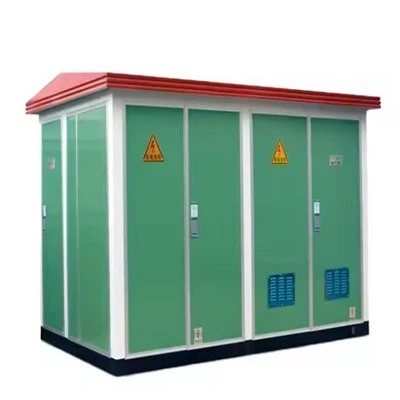


Why does a 3 phase distribution transformer have three wires on the high-voltage side and four on the low-voltage side? Learn how star-connected windings, neutral connections, and three-phase four-wire distribution support industrial and single-phase loads.
Introduction
If you look at a typical three-phase distribution transformer, you may notice something interesting: three wires enter from the high-voltage side, but four wires come out of the low-voltage side.
Why does a transformer need an extra wire?
The answer is not simply that the voltage becomes lower. The main reason is that the high-voltage side and low-voltage side serve different purposes.
The high-voltage side is mainly used to receive and transfer three-phase electrical power. The low-voltage side, however, often needs to supply both three-phase industrial equipment and single-phase electrical loads.
This difference in application explains why many distribution transformers use a three-phase, three-wire connection on the high-voltage side and a three-phase, four-wire connection on the low-voltage side.
1. Why Does the High-Voltage Side Usually Have Three Wires?
In a typical three-phase power distribution system, the high-voltage side of a transformer receives power through three phase conductors: L1, L2, and L3.
These three conductors carry the three-phase electrical supply. A neutral conductor is generally not required for transmitting balanced three-phase power to the transformer.
High-voltage transmission and distribution systems are designed to transfer electrical energy efficiently over long distances. For a given power level, increasing the voltage reduces the current.
Since line losses are proportional to the square of the current, lower current helps reduce transmission losses.
For this reason, three-phase high-voltage systems commonly use three phase conductors without a neutral wire.
For example, a distribution transformer may receive power at 10 kV, 11 kV, or 33 kV, depending on the local distribution network.
2. Why Does the Low-Voltage Side Need Four Wires?
The low-voltage side has a different job.
It may need to supply:
Three-phase motors and industrial machinery
Pumps, compressors, and production equipment
Single-phase lighting and socket outlets
Office equipment and other auxiliary loads
These loads do not all use the same voltage.
In a common 380/220 V or 400/230 V distribution system, three-phase equipment uses the voltage between two phase conductors, while single-phase equipment uses the voltage between one phase conductor and neutral.
To provide both types of supply, the transformer secondary is commonly designed with a star (wye) connection.
3. How Does a Star-Connected Transformer Produce a Neutral Wire?
In a star-connected secondary winding, one end of each of the three phase windings is connected together.
This common connection forms the neutral point.
The other three winding ends are connected to the three phase output terminals.
The transformer therefore provides four low-voltage conductors:
L1: Phase 1
L2: Phase 2
L3: Phase 3
N: Neutral
The neutral conductor is brought out from the common winding connection, allowing the transformer to supply both three-phase and single-phase loads.
This is why the low-voltage side has one more wire than the high-voltage side.
4. How Can One Transformer Supply Both 380 V and 220 V Loads?
The voltage available depends on which conductors are connected to the load.
In a typical 380/220 V system:
|
Connection |
Voltage |
Typical Application |
|
Phase to phase |
380 V |
Three-phase motors and industrial equipment |
|
Phase to neutral |
220 V |
Single-phase lighting and socket loads |
For example, a factory may use 380 V to operate production machinery while supplying 220 V to office lighting, control equipment, and auxiliary circuits.
A single distribution transformer can provide both types of supply, provided its winding configuration and rated capacity are suitable for the connected loads.
This arrangement is widely used in industrial facilities, commercial buildings, and distribution networks.
5. Does the Neutral Wire Carry Current?
Yes. The neutral wire can carry current when the three-phase loads are unbalanced.
In a perfectly balanced three-phase system, the phase currents cancel each other at the neutral point, resulting in zero neutral current.
However, real distribution systems often include single-phase loads connected unevenly across the three phases.
When the phase currents are not equal, the neutral conductor carries the resulting current.
The neutral is therefore an important part of the distribution system, especially where single-phase loads are present.
It should not be confused with the protective earth (PE) conductor, which serves a different safety function.
6. What Should Buyers Consider When Selecting a Distribution Transformer?
For project buyers, understanding the secondary connection is important when specifying a transformer.
Before placing an order, confirm:
Primary and secondary voltage ratings
Three-phase or single-phase load requirements
Secondary winding connection, such as Dyn11 or Yyn0
Neutral terminal requirements
Rated capacity and expected load balance
Applicable local electrical standards
For example, a transformer specified as 11kV / 0.4kV with a Dyn11 vector group typically has a delta-connected high-voltage winding and a star-connected low-voltage winding with a neutral brought out.
This configuration is commonly used for three-phase, four-wire distribution.
However, the appropriate vector group and winding arrangement depend on the project's system design, grounding method, and load requirements.
Conclusion
The reason a transformer has three wires on the high-voltage side but four on the low-voltage side is that the two sides serve different electrical needs.
The high-voltage side typically uses three phase conductors to receive power efficiently.
The low-voltage side often uses a star-connected winding with a neutral point, allowing it to supply both three-phase industrial equipment and single-phase loads.
For distribution transformer buyers, understanding this connection helps ensure that the selected transformer matches the voltage requirements, load characteristics, and distribution system design of the project.
At Zhejiang Hengli Electrical, distribution transformers can be configured according to project-specific voltage ratings, winding connections, and application requirements. Buyers can provide their technical specifications to confirm a suitable transformer design before procurement.
Frequently Asked Questions
Why does a three-phase transformer have a neutral wire?
A neutral wire is commonly provided on the low-voltage side to supply single-phase loads and serve as the neutral reference point in a star-connected system.
Can a three-phase transformer supply both single-phase and three-phase loads?
Yes. A transformer with a suitable three-phase, four-wire secondary can supply both types of loads, provided the rated capacity and phase loading are properly considered.
Is the neutral wire the same as the ground wire?
No. Neutral is a circuit conductor connected to the transformer winding neutral point. Protective earth is used for electrical safety. Their connection depends on the grounding arrangement specified for the system.
Do all transformers have four wires on the low-voltage side?
No. The number of output conductors depends on the winding configuration and application. Some transformers provide three-phase, three-wire output, while others provide three-phase, four-wire output with a neutral.